Her Life
Introduction
Few artists win lasting renown without salting away a significantly-sized body of work and Mabel Pryde Nicholson, who waited until her four children were grown to paint in earnest and died suddenly at 47, wasn’t granted that chance.
Even so, her finest pictures – figures in Commedia dell’Arte costume; cryptic, beautifully muted portrait-interiors – all painted in the early 1900s, suggest an artist of such tensile strength that you have to wonder what she might have become.
A born rebel with a resourceful intelligence, Mabel lived through the successive blastings that Parisian ‘isms’, the Bloomsbury Group and the vorticists brought to late Edwardian Britain, but did not throw her lot in with any of them. Her painterly preoccupations were in the field reserved for personal experience; what her contemporary Walter Sickert described as ‘the magic and poetry which [artists] daily see around them.’ Her children in particular – Ben, Tony, Nancy and Kit – are viscerally bound into her practice.
Mabel’s story slipped from history’s grasp amid the blizzard of death brought by the Great War (she died of ‘Spanish Flu’ in the conflict’s final months), and also the artistic successes of particularly the men in her family: her husband William Nicholson (the society portraitist and virtuoso still life painter), her sons Ben (the pioneer of British abstraction) and Kit (a modernist architect); perhaps also her brother, James Ferrier Pryde (a once vogueish painter of shadowy interiors).
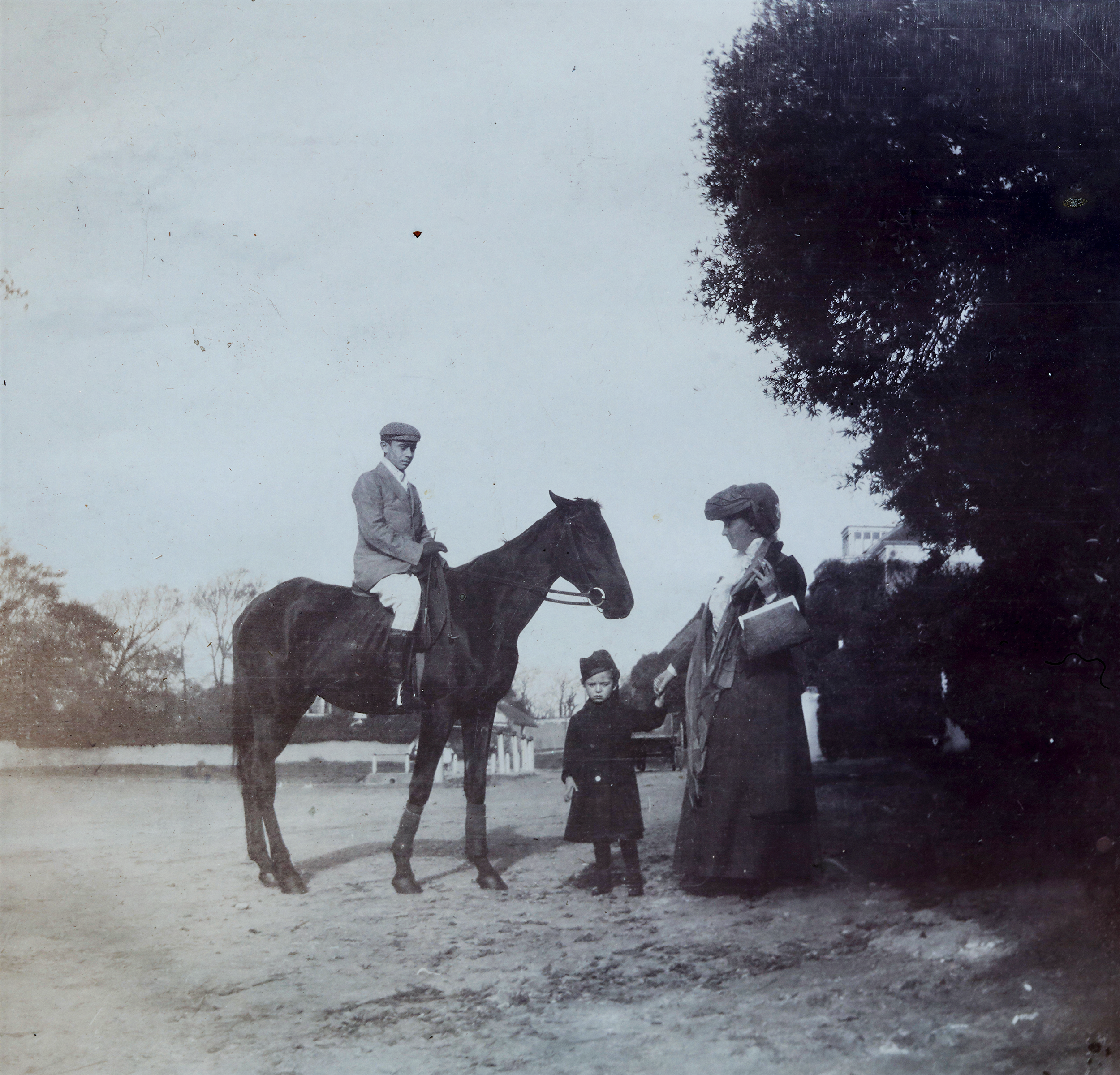
The difficulty of extracting Mabel from their shadow is compounded by her having left little hard trace of herself, not least by ripping, snipping or scratching her face from a number of photographs in her family album. In those she left intact, her looks can change from shot to shot. There’s a smeared palette, a bundle of letters, almost all to Ben (saved because his personal papers were purchased by the Tate), her paintings of course, a jumble of reminiscences from those who knew her, questionable opinions from many who didn’t.
The fullest account of her life was written by William’s late-life partner, the novelist Marguerite Steen, who rode roughshod over history to present her long-dead rival as nervy, glowering, indolent, spendthrift and insular; William’s first marriage as one that, ‘left no happy memories behind’.
Some of Ben’s biographers have hardly been kinder, despite his insistence that she was ‘the rock on which my whole existence is based’. Her ‘purpose and integrity . . . was the thing that meant most to me in that home life,’ he wrote. ‘That and her friendship and the fact she backed me up completely.’ Piecing all of this together can feel like gathering the shards of a broken mirror and finding they don’t quite fit.
Mabel met William at art school, where she earned some notoriety for devilment (‘All the small stories I remember about mother,’ said Ben, ‘are of her vitality and busting up of conventions.’). Like most women of her time, however, she put aside painting on marriage and when she returned, fit it around her other responsibilities – the social visits and the endless organising of meals, sending her children the books and clothes they requested in letters from school.
Holding those incompatible parts of her in tension felt at many times to her to be practically and psychologically impossible. ‘It is such a relief to feel I am free for the moment as I haven’t been able to leave the children at all since I came back,’ she wrote to Ben in 1914. ‘My head is full of little rotten servant worries.’ They were close, and her conundrum was not lost on him: writing to the collector Marcus Brumwell in 1949 he reflected that ‘she had the power and purpose and I think the “idea” too but expended all on her family as so many women have done.’
Still, one wouldn’t want to deny her agency. Mabel knew and socialised with most of the leading English and a number of French painters and discussed with them the latest developments in avant-garde painting. She also knew their patrons and dealers, several of whom showed her work. In fact, once she did begin to paint, she rose by leaps and bounds, making ‘in depth what she could not attempt in width,’ as her son-in-law, the poet Robert Graves put it. Her disappearance from the story of British modernism is thus all the more unjust.
Extracted from Mabel Nicholson by Lucy Davies, published by Eiderdown Books.
Early Life
Mabel Scott Lauder Pryde was born in Edinburgh in February 1871, the youngest child of Dr David Pryde – headmaster of a prestigious girls school in Edinburgh – and his wife Barbara, whose uncles had been Royal Scottish Academicians.
Mabel’s father was a great friend of the actors Henry Irving and Ellen Terry and often took Mabel and her siblings – Isabella, Janet (known as Nettie), Jimmy (the noted artist James Ferrier Pryde), Fanny and Dora – to the Lyceum Theatre. Mabel later drew on the tense atmosphere and smoky chiaroscuro of an auditorium in her painting, and many of her works also feature costumes.
Aged 17, Mabel went to the then world-famous Bushey Art School in Hertfordshire, run by the German-born Royal Academician Hubert von Herkomer. Probably because she once drove a flock of geese into the life studio, she came to the attention of fellow student William Nicholson and in April 1893, they ran away to be married.
They would have four children in all: Ben in 1894; Anthony or ‘Tony’, in 1897; Annie, always ‘Nancy’, in 1899; and Christopher, or ‘Kit’ in 1904.
William’s biographer Marguerite Steen wrote that ‘with the birth of the children, [Mabel’s] whole horizon had narrowed to the domestic scene. As each child appeared she idolised it more than the last. To be separated from them, if only for a day, made her miserable.’

Dr David Pryde and Barbara Pryde (centre) with two of their daughters and a friend, probably London, 1890s (with kind permission of Bushey Museum)
A Bloomsbury Family
William Orpen’s 1907 portrait of the Nicholsons, A Bloomsbury Family, pictures the Nicholson’s at their London townhouse in Mecklenburgh Square.
The Orpens were then the Nicholsons’ particular friends and Ben recalled that “whenever Grace Orpen and my mother got together they became completely wild”. A holiday in Margate ended with the wives “far out to sea in full evening dress almost up to their necks (and as my father remarked, my mother was in a new Paquin model as yet unpaid for)”.
Bloomsbury was then a hotbed of new radical thought. Half a mile from the Nicholson’s front door, the nascent Bloomsbury Group were meeting, and Mecklenburgh Square itself was home to various Suffragist organisations. Nancy, then 8 or 9, is said to have chalked ‘Votes for Women’ above the maid’s kitchen sink.
In 1903, 1905 and 1907, the family summered in the fashionable French resort of Dieppe with friends. The town was swarming with artists, including Jacques-Emile Blanche, Walter Sickert and the future Camden Town Group, who joined the Nicholsons at the Café des Tribunaux and the Hotel Lefèvre.
It’s possible that the town's atmosphere had a part to play in Mabel’s artistic renascence: at some point in 1905, she dusted off her palette. In common with many women artists, she painted what was most easily at hand – her young children and the interiors of her homes. When her children sat for her, she insisted on paying them a fee.
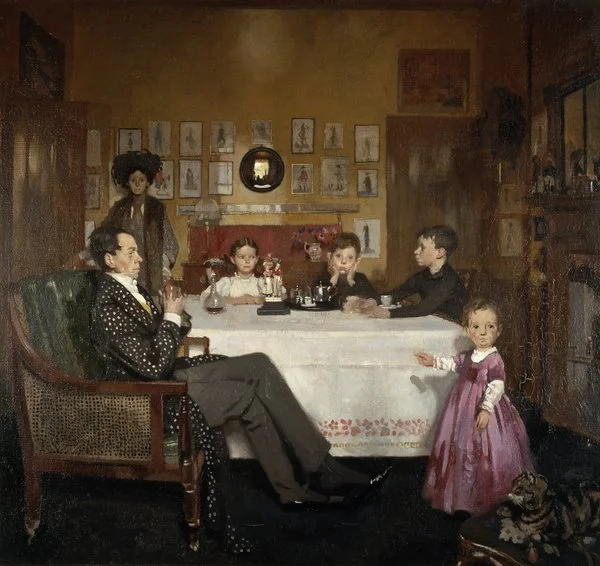
‘A Bloomsbury Family’ (1907) by Sir William Orpen (National Galleries of Scotland)
Life at the Grange
In 1909, William and Mabel bought The Grange, a Georgian vicarage on the Sussex coast at Rottingdean.
Ben’s friend, the artist Paul Nash, who came to stay in 1911, remembered ‘highly polished painted walls, stiff calendered chintzes, gay pink and greys. At every meal we ate blancmange with bright-coloured jam, in keeping with the brightness of the rooms.’
Mabel painted some of her finest work here, including The Grange (1911, Scottish National Gallery), a double portrait of Nancy and Kit in a recessing, stage set-like interior, and Family Group (c1911, Tate), a conversation piece featuring Tony, Nancy, Kit and the family nanny beneath a large model ship.
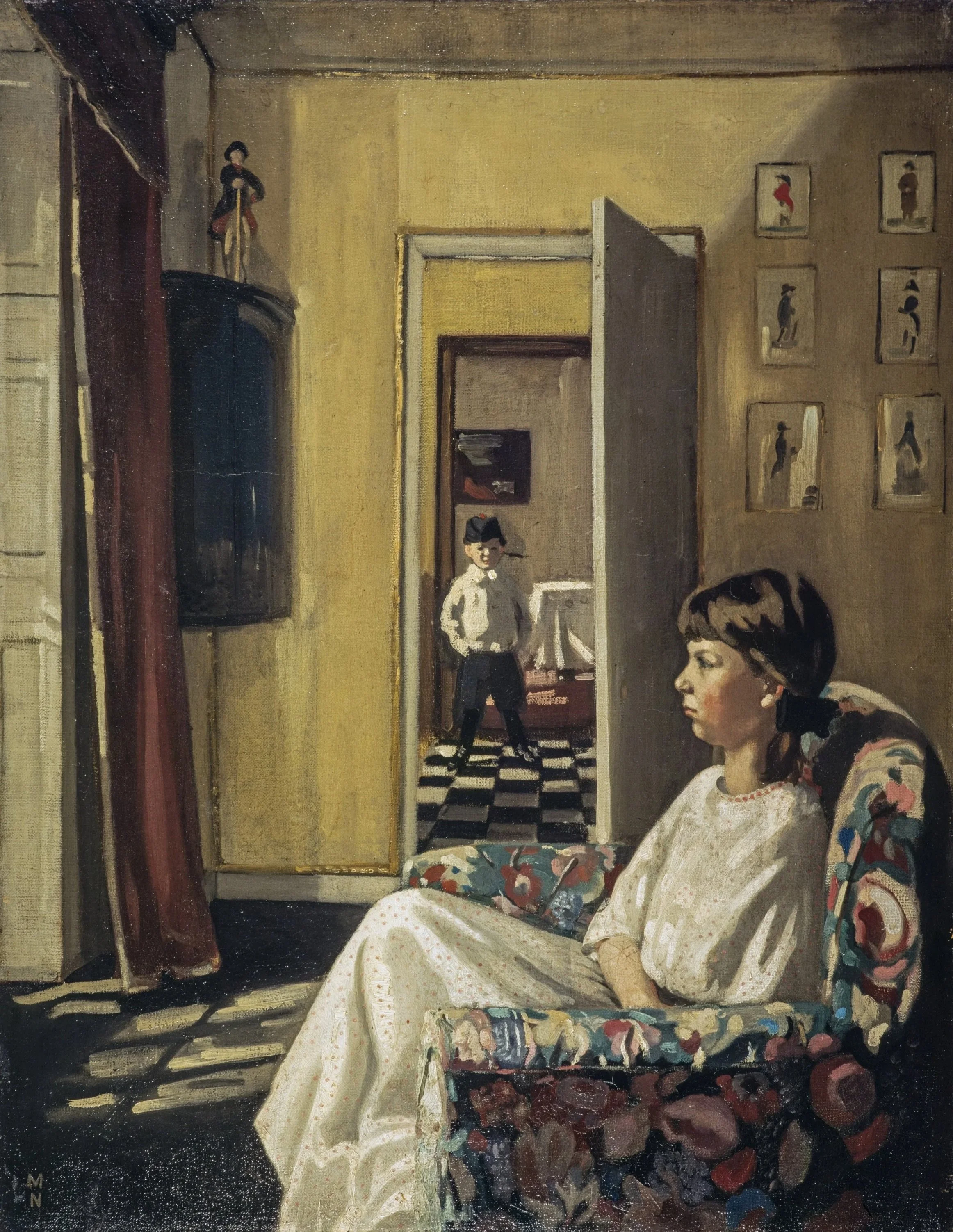
‘The Grange, Rottingdean’ (1911) by Mabel Pryde Nicholson (National Galleries of Scotland)
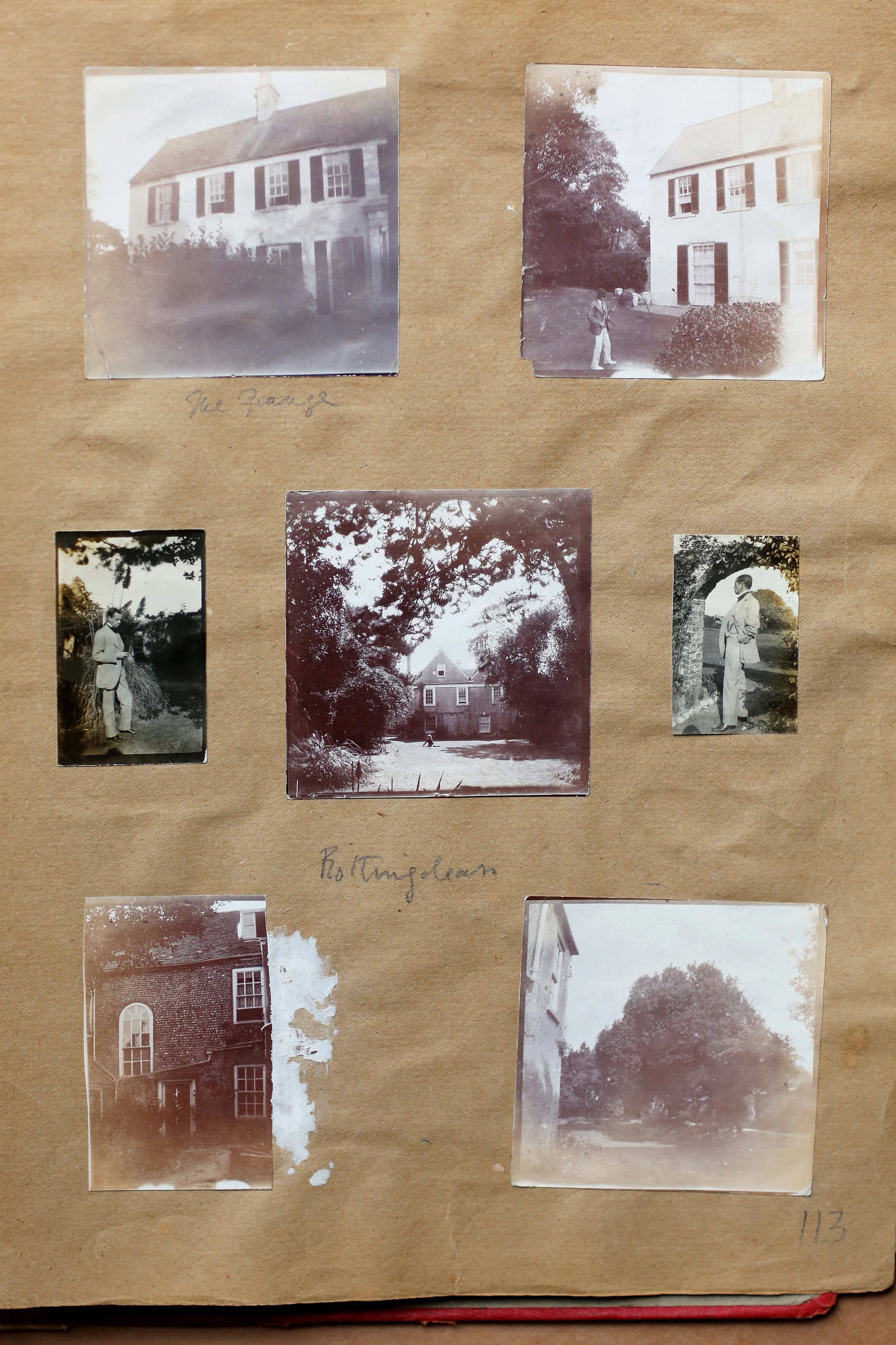
Page from Mabel’s photo album showing Rottingdean, c1909-1914 (private collection)
Painting career, the London art World
In 1910, Mabel exhibited her first painting at the New English Art Club. She also showed at the annual ‘Salon’ of the Goupil Gallery, one of the leading West End dealers – and at the International Society, a forum for independents whose first presidents were James Abbott McNeill Whistler and Auguste Rodin.
Perhaps 1912 was Mabel’s year: she was given a solo show at the Chenil Gallery in Chelsea, and made enough from the sale of a single painting – ‘Kit in the Glass with Nancy and Sammy’ (untraced) – to commission from Lutyens a thatched wooden studio in The Grange’s rear garden. According to Ben, his father “quickly annexed it on the plea of urgency in earning money.” Certainly its large north-facing window is recognisable in some of his paintings.
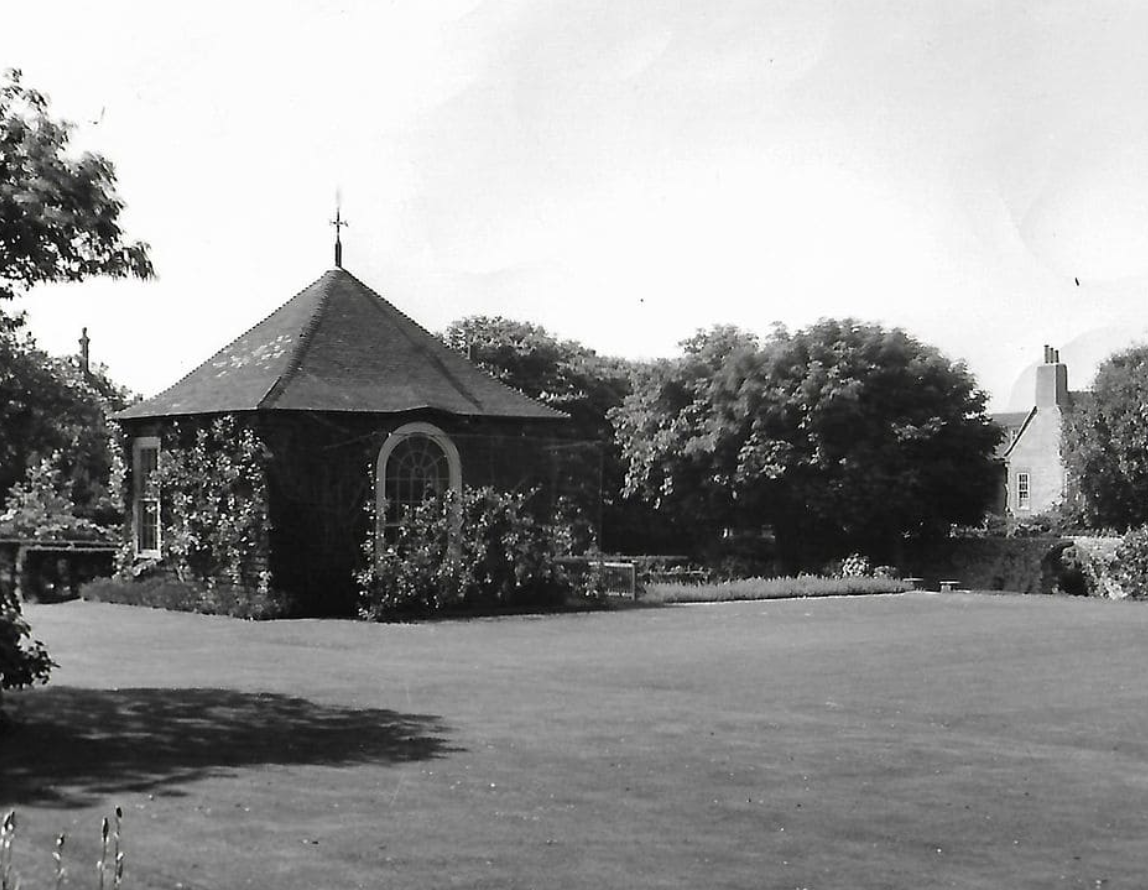
The studio Mabel commissioned from Edwin Lutyens in the garden
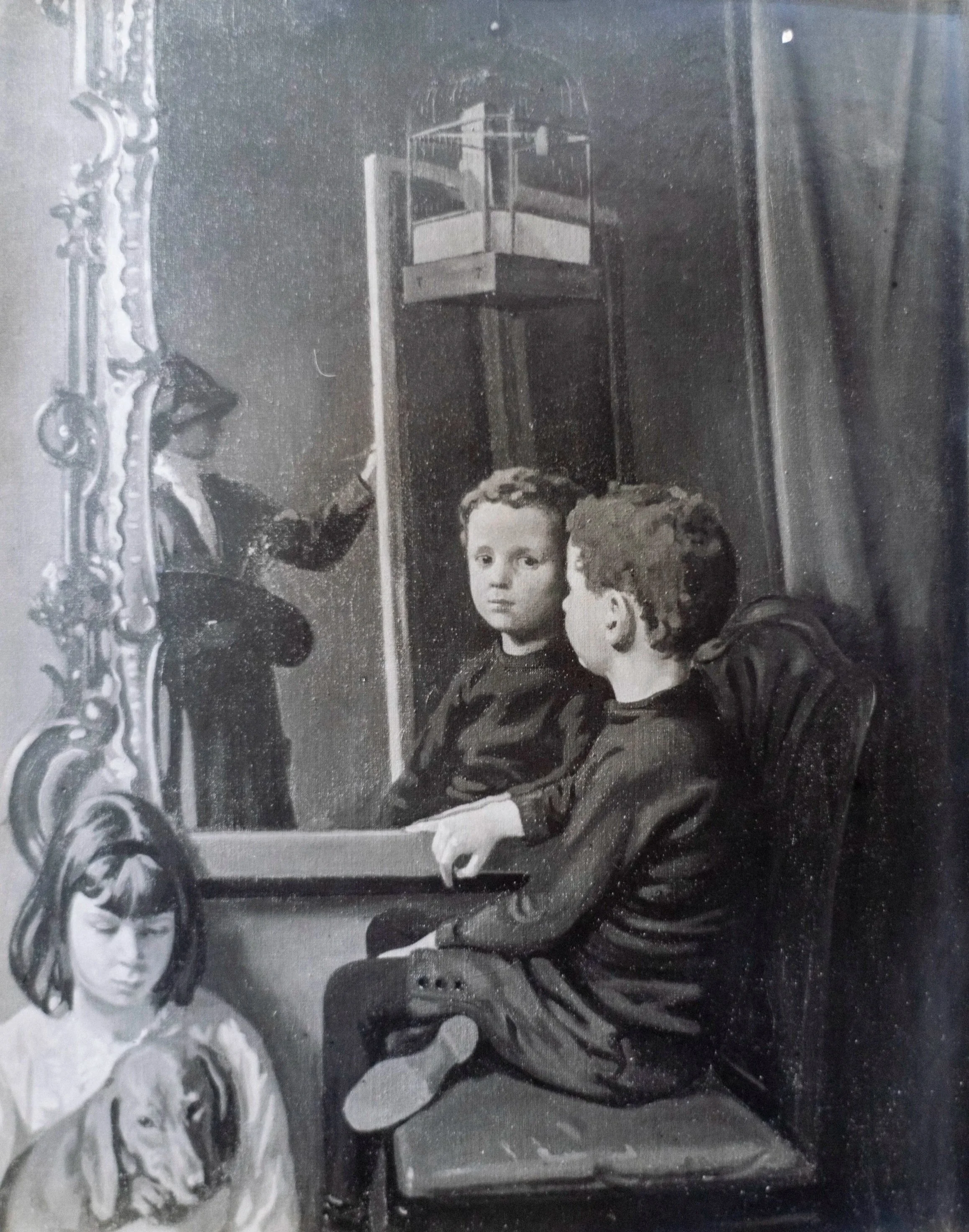
‘Kit in the Glass with Nancy and Sammy’ (c1912) by Mabel Pryde Nicholson (untraced)
War, Death and Legacy
In 1914, William accepted an invitation to travel to India with Lutyens for six months. The Grange was sold, and Mabel leased a house by the sea at Harlech.
The poet Robert Graves’s family lived nearby. It was here that he first caught sight of 17-year-old Nancy, in 1916. They married in 1918.
‘I liked all the family,’ Graves wrote in his memoir Goodbye to All That, ‘particularly her mother…a beautiful, wayward Scotch-melancholy person.’
Ben’s asthma made him exempt from conscription, but Tony was called up and in April 1917, sent to the front in France. Tragedy hit the family in July 1918 when, while Tony was home on leave, Mabel contracted Spanish Flu. ‘She wanted so much to be with Tony,’ wrote Graves, that ‘when the doctor came, she took quantities of aspirin, reduced her temperature and pretended to be all right.’ She died in London a few days later.
Within three months, Tony would die of gunshot wounds in France.
In 1920, Ben and Nancy staged a memorial exhibition comprising 28 of Mabel’s paintings at the Goupil Gallery, for which Graves wrote the catalogue note.
It was favourably reviewed by The Times and Sunday Times, who wrote that, among her cohort, “Mrs Nicholson holds as distinct and honourable a rank as did Berthe Morisot among the French impressionists”.
Afterwards, Mabel’s reputation faded. By 1956, the art dealer and historian Lillian Browse, whose book about William was for many years considered definitive, thought fit to describe Mabel as “a somewhat inconsequent wife”. William had been dead seven years by then and could not refute it. All their lives, however, Mabel’s children fought to rescue and defend her.
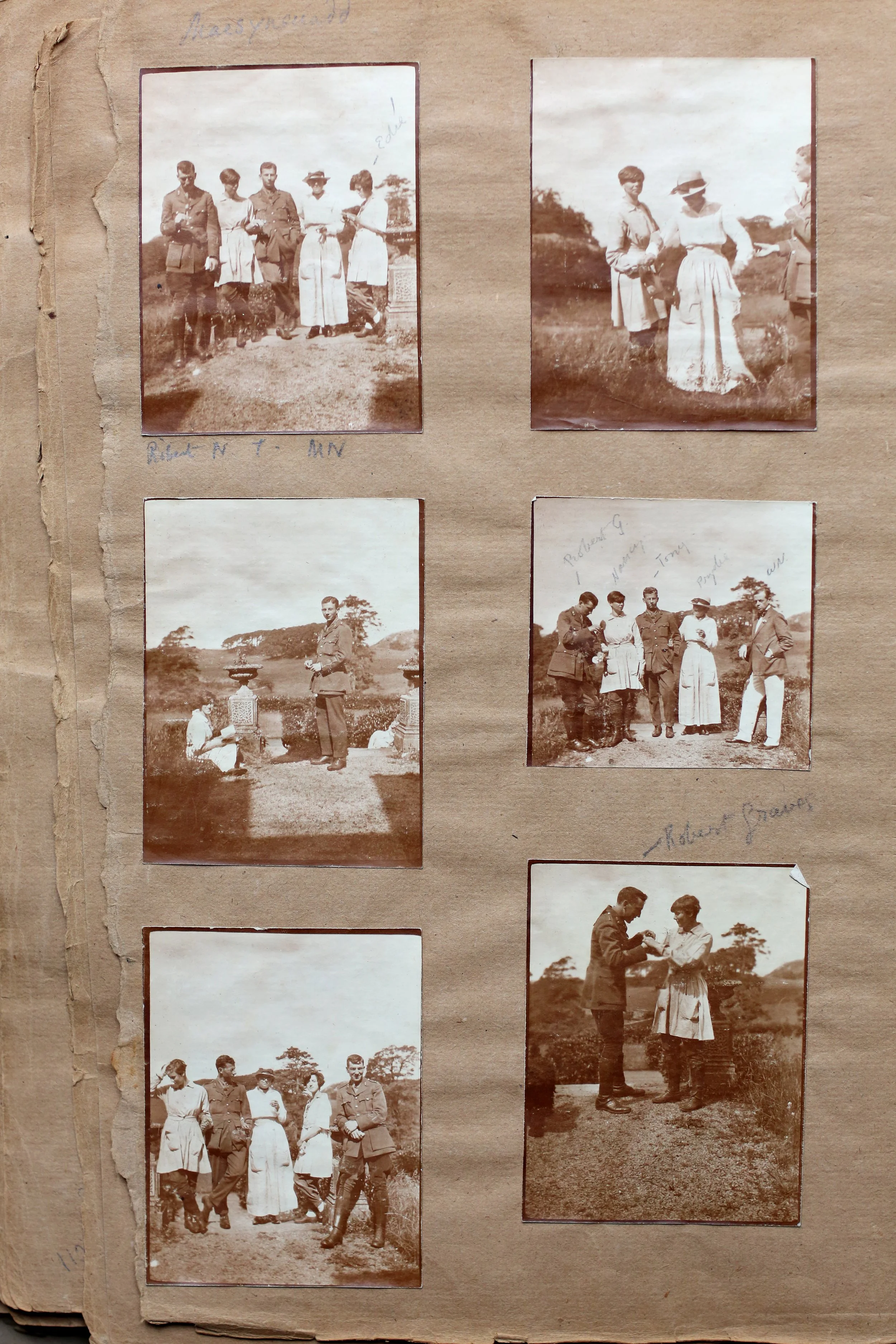
Page from Mabel’s photo album showing the family and friends including Robert Graves at Harlech in 1918 (private collection)
In 2024, The Grange Art Gallery held the first exhibition of Mabel’s work in more than 100 years, and a small monograph was published to coincide.